
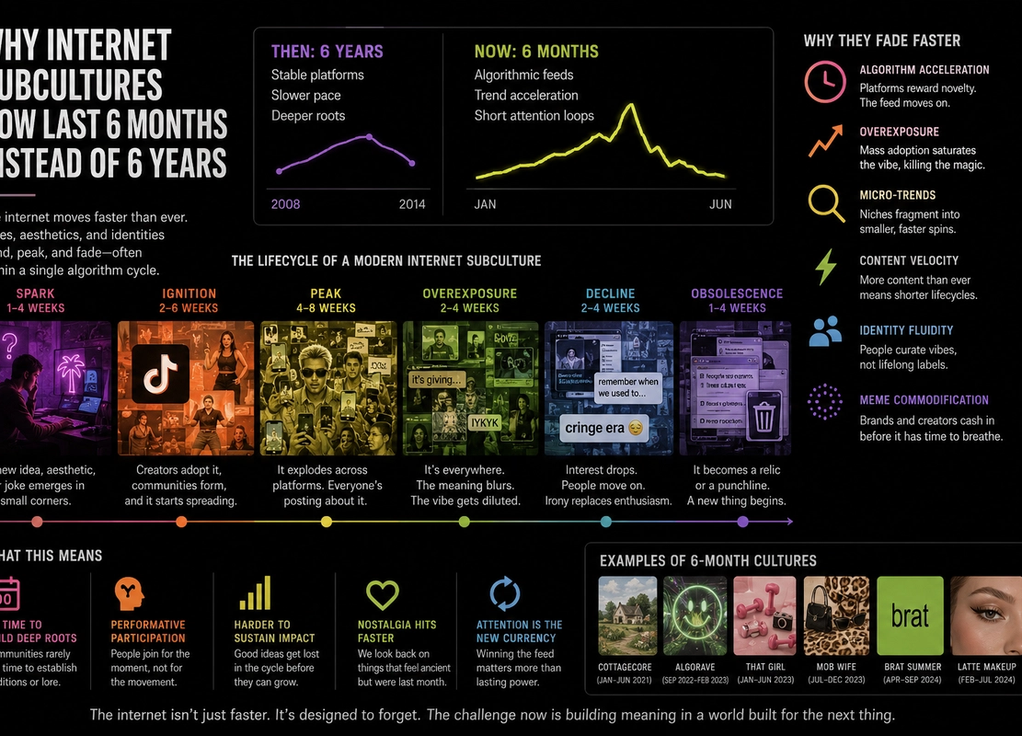
Why Internet Subcultures Now Last 6 Months Instead of 6 Years
Mary Shelby
June 3, 2026
The internet has always been a place where communities form around shared interests. From early forums and fan sites to modern social media platforms, people have gathered online to exchange ideas, develop identities, and build cultures of their own. In the past, many internet subcultures could thrive for years, gradually growing and evolving over time.
Today, the lifecycle looks very different. New aesthetics, communities, memes, and online identities can appear almost overnight, dominate conversations for a few months, and then fade just as quickly. What once took years to develop can now rise and fall within a single season.
The question is not why internet subcultures emerge so frequently. It is why they seem to disappear so fast.
Key Takeaways
- Social media accelerates the growth and decline of online communities
- Algorithms reward novelty and constant change
- Trends spread to mainstream audiences much faster than before
- Online identities have become more flexible and temporary
- Digital culture now moves at a speed that makes long-lasting subcultures harder to sustain
1. Algorithms Reward Newness
In the early internet, people often discovered communities through forums, blogs, or niche websites. Growth was relatively slow, allowing cultures to develop gradually and maintain a sense of stability.
Modern social media platforms operate differently. Algorithms are designed to prioritize fresh, engaging content that captures attention quickly. As a result, new trends receive massive exposure in a short period of time.
This creates a constant cycle where newer communities are continually competing with older ones for visibility. The moment a trend begins to feel familiar, another one is already waiting to replace it.
2. Trends Reach the Mainstream Faster
In the past, a niche online community could remain relatively hidden for years. Membership often required actively seeking out specific websites, forums, or interest groups.
Today, platforms can expose millions of people to a trend within days. A small online community can suddenly find itself featured in viral videos, news articles, and recommendation feeds.
While this visibility helps subcultures grow quickly, it can also weaken their sense of exclusivity. Once a niche identity becomes mainstream, many early participants move on in search of something new.
3. Online Identities Are More Fluid
Previous generations often spent years identifying with a particular music scene, fandom, gaming community, or online culture. These identities became part of how people saw themselves.
Modern internet users tend to move between communities more easily. Someone may participate in multiple online spaces simultaneously and adopt different interests depending on what captures their attention at the moment.
This flexibility allows people to explore more interests, but it also reduces the likelihood of remaining committed to a single subculture for long periods.
4. Content Cycles Move Faster Than Ever
The sheer volume of content produced online is staggering. Every day, millions of videos, posts, images, and discussions compete for attention.
Because there is always something new to discover, trends rarely have time to mature. Communities often spend more energy responding to the next wave of content than deepening their existing culture.
As attention becomes increasingly fragmented, maintaining long-term momentum becomes more difficult.
5. Participation Has Become Easier
Joining an online subculture once required effort. People might spend months learning community norms, participating in discussions, and building relationships.
Today, participation is often as simple as changing a profile picture, using a hashtag, following a trend, or posting a short video. While this accessibility allows communities to grow rapidly, it can also make them less stable.
When entry requires little commitment, leaving requires little commitment as well.
Why Some Communities Still Endure
Despite these changes, not every online community disappears quickly. Certain subcultures continue to thrive for years because they are built around enduring interests rather than temporary trends.
Communities centered on hobbies, creative pursuits, professional fields, or deeply shared passions often develop stronger foundations. Their members remain engaged because the interest itself continues to provide value long after the initial excitement fades.
The difference is that these communities tend to grow more slowly and receive less attention than rapidly emerging trends.
The Age of Accelerated Culture
The internet has transformed how culture spreads. Ideas that once took years to circulate can now reach global audiences in hours. While this speed creates exciting opportunities for creativity and connection, it also shortens the lifespan of many online movements.
Subcultures have not disappeared. They simply exist within an environment that rewards constant novelty and rapid change. As a result, communities form faster, evolve faster, and often fade faster than ever before.
In today’s digital world, six months can sometimes feel like six years. And for many internet subcultures, that may be exactly how long they have before the next wave arrives.