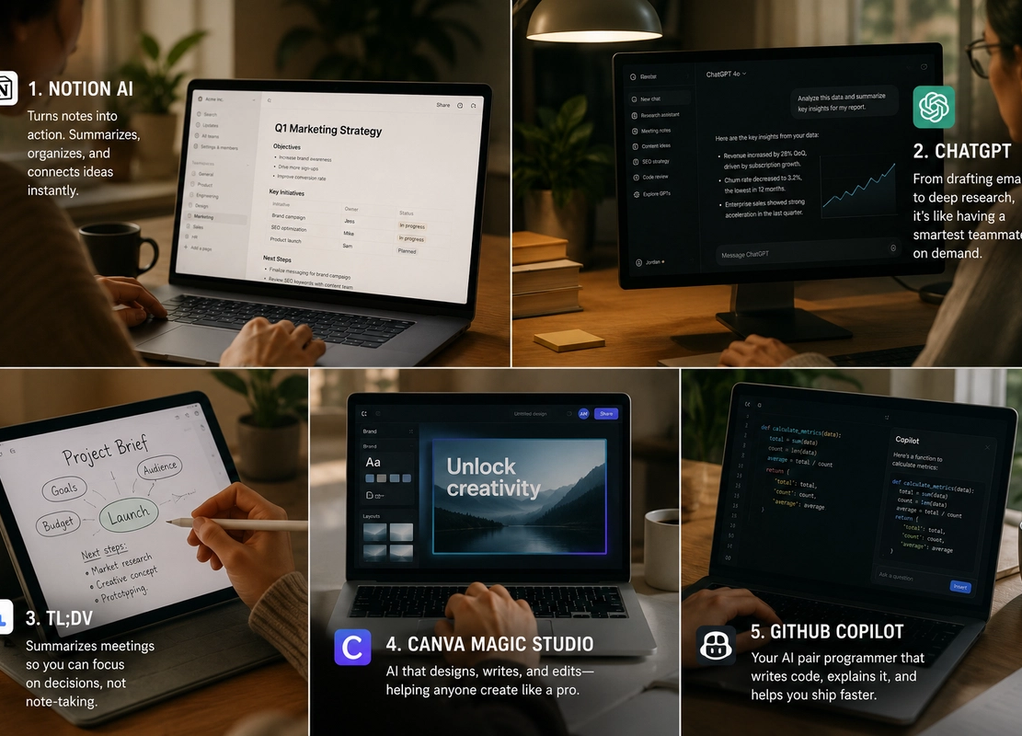
5 AI Tools Quietly Changing How We Work
Mary Shelby
June 6, 2026
Artificial intelligence is often discussed through headlines about major breakthroughs, futuristic predictions, or concerns about automation. Yet some of the biggest changes are happening more quietly. Instead of replacing entire jobs, many AI tools are helping people work faster, make better decisions, and spend less time on repetitive tasks.
What makes these tools interesting is that they are becoming part of everyday workflows. Millions of people now use AI not because it feels revolutionary, but because it saves time and reduces friction. As these tools continue to improve, they are gradually reshaping how work gets done across industries.
Key Takeaways
- AI is increasingly being used to enhance productivity rather than replace workers
- Many of the most impactful tools focus on saving time and reducing routine work
- AI assistants are becoming integrated into daily workflows
- Automation is expanding beyond technical fields into everyday tasks
- Small productivity gains can create significant long-term benefits
1. AI Writing Assistants
Writing has become a major part of modern work. Emails, reports, proposals, marketing content, and documentation consume countless hours every week. AI writing assistants help speed up this process by generating drafts, improving clarity, checking grammar, and refining tone.
Rather than replacing human communication, these tools often act as collaborators. They help users move past blank pages, organize ideas, and edit content more efficiently. For many professionals, AI writing assistance has become as common as spellcheck once was.
2. Meeting Summarization Tools
Meetings generate large amounts of information, but important details are often forgotten or buried in notes. AI-powered meeting assistants can record conversations, create summaries, identify action items, and highlight key decisions.
This reduces the need for manual note-taking and allows participants to focus on the discussion itself. Teams can quickly review what was covered, making collaboration more efficient and reducing misunderstandings.
As remote and hybrid work continue to grow, these tools are becoming increasingly valuable.
3. AI Research Assistants
Finding reliable information has become both easier and more complicated. While information is widely available, sorting through it can be time-consuming.
AI research assistants help users gather information, summarize complex topics, compare sources, and identify key insights more quickly. Instead of spending hours reviewing multiple documents, users can often gain a useful overview in minutes.
For knowledge workers, researchers, students, and business professionals, this can significantly reduce the time required to learn about unfamiliar subjects.
4. Workflow Automation Tools
Many workdays are filled with repetitive administrative tasks. Updating spreadsheets, organizing data, moving information between platforms, and managing routine processes can consume valuable time.
AI-enhanced automation tools help streamline these activities by connecting applications, handling repetitive actions, and reducing manual effort. Employees can spend less time on routine tasks and more time on work that requires creativity, judgment, and problem-solving.
The impact is often subtle but substantial when multiplied across weeks and months.
5. AI-Powered Search and Knowledge Tools
Modern organizations generate enormous amounts of information. Finding the right document, policy, presentation, or piece of knowledge can sometimes feel harder than creating it.
AI-powered search tools improve access to information by understanding context and intent rather than relying solely on keywords. Employees can locate answers more quickly and spend less time searching across emails, documents, and internal systems.
This seemingly small improvement can significantly boost productivity across large teams.
Why These Tools Matter
The most important AI tools are not necessarily the ones making the biggest headlines. Many of the most meaningful changes come from reducing everyday friction.
Saving ten minutes on an email, avoiding an hour of note-taking, or finding information more quickly may seem minor in isolation. However, when these improvements occur repeatedly throughout the day, they create substantial gains in productivity and focus.
This is why many organizations are adopting AI gradually rather than dramatically. The value often comes from dozens of small efficiencies rather than one major transformation.
The Future of Everyday Work
AI is becoming less of a standalone technology and more of an invisible layer built into the tools people already use. As this trend continues, the distinction between “AI tools” and ordinary workplace tools may begin to disappear.
The real transformation is not that people are working less. It is that they are increasingly able to spend less time on repetitive tasks and more time on meaningful work.
The AI revolution may not always arrive with dramatic announcements. In many cases, it is already happening quietly—one workflow, one task, and one saved minute at a time.