The Strange Origins of Famous Tech Company Names
Mary Shelby
June 6, 2026
Some of the world’s biggest technology companies have names that feel completely natural today. We use them so often that it is easy to forget they were once unfamiliar words attached to unknown startups. Yet many of these names have surprisingly unusual origins.
Some were inspired by mathematics, others by fruit, spelling mistakes, science fiction, or even random brainstorming sessions. In many cases, the stories behind these names reveal how unpredictable the early days of successful companies can be.
Key Takeaways
- Many famous tech company names have unexpected origins
- Some names were chosen for simplicity rather than deep meaning
- Several companies were inspired by science, mathematics, or literature
- Branding often evolves after the name is chosen
- A memorable name does not always predict future success
1. Apple: A Fruit That Stood Out
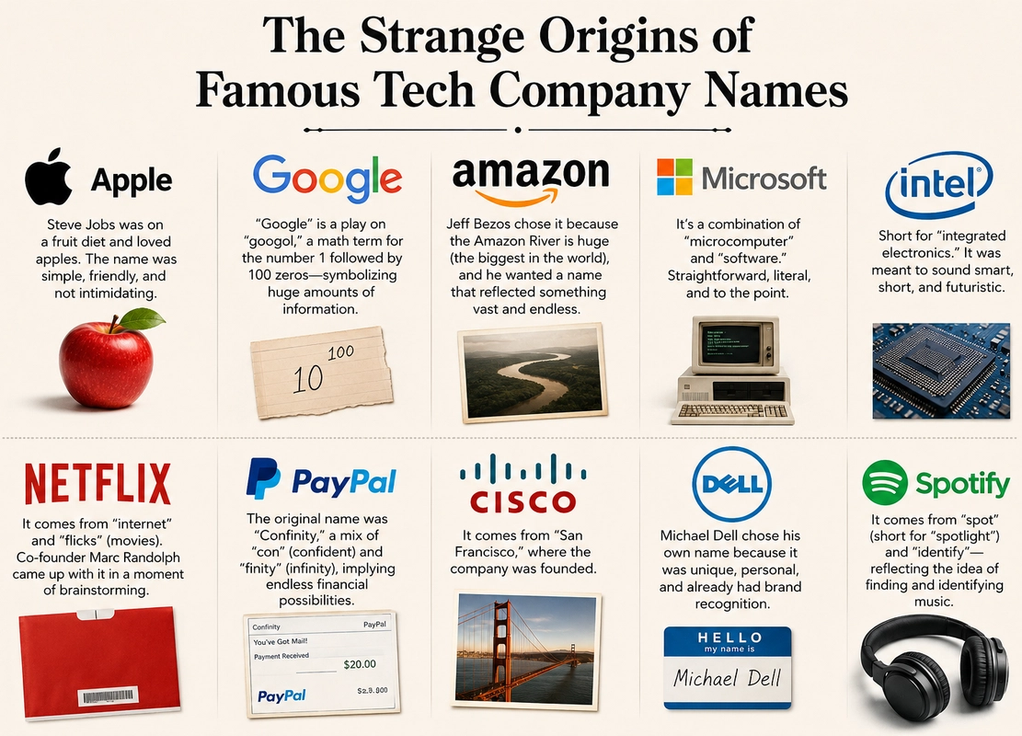
Today, Apple is one of the most recognizable brands in the world. However, its name was surprisingly simple.
According to co-founder Steve Jobs, he suggested the name after spending time at an apple orchard and feeling that the word sounded friendly, approachable, and less intimidating than traditional technology company names.
At a time when many tech firms had highly technical names, “Apple” felt different. Its simplicity helped the company stand out and made technology seem more accessible to everyday consumers.
2. Google: A Misspelled Mathematical Term
The name Google originated from the mathematical term “googol,” which refers to the number 1 followed by 100 zeros.
When founders Larry Page and Sergey Brin were developing their search engine, they wanted a name that reflected the enormous amount of information they hoped to organize.
During the naming process, a variation of the word was written as “Google.” The spelling stuck, and one of the world’s most famous brands was born from what was essentially a misspelling.
3. Amazon: Inspired by the World’s Largest River
When Jeff Bezos was searching for a company name, he wanted something that suggested scale and ambition.
He chose Amazon after the Amazon River, the largest river system in the world. The name reflected his vision of building a company that would eventually become the largest marketplace possible.
The choice also had a practical advantage. At the time, company directories were often listed alphabetically, and starting with the letter “A” helped improve visibility.
4. Adobe: Named After a Creek
Some company names have surprisingly personal origins. Adobe is one example.
The company was named after Adobe Creek, a small waterway that ran behind the home of co-founder John Warnock.
Unlike names chosen through extensive branding exercises, Adobe’s name came from a familiar local landmark. Few people using its software today realize that the company owes its identity to a creek in California.
5. Cisco: A Shortened City Name
Many people assume Cisco is a technical acronym, but the reality is much simpler.
The name comes from the final part of San Francisco, where the company was founded. The logo even incorporates imagery inspired by the city’s famous bridge.
The shortened name gave the company a modern and memorable identity while maintaining a connection to its origins.
Why Unusual Names Often Work
One reason many technology companies choose unusual names is that they are easier to remember. Familiar words used in unexpected ways can create curiosity and stand out in crowded markets.
Interestingly, many of these names gained meaning only after the companies became successful. Today, words like Google or Amazon immediately evoke specific brands, even though their original meanings were entirely different.
This shows that a strong company often creates the power of its name rather than the other way around.
The Stories Behind the Logos
It is tempting to assume that famous companies spent years crafting perfect brand identities before launching. In reality, many names emerged from simple ideas, personal experiences, or practical decisions.
What began as a fruit, a mathematical term, a river, a creek, or part of a city name eventually became globally recognized brands. The names themselves were not magical. The companies built the meaning around them over time.
Perhaps that is the most surprising lesson of all. A great company name does not need to sound revolutionary from the beginning. Sometimes it just needs a good story—and a successful company behind it.