5 Tech Trends That Will Define the Next Decade
Moran Sapir
June 6, 2026
Predicting the future of technology is never easy. Many innovations that once seemed revolutionary faded away, while others transformed society in ways few people expected. Yet certain trends are already gaining enough momentum to suggest they will play a major role in shaping the years ahead.
The next decade will likely be defined not by a single breakthrough, but by several technologies working together to change how people live, work, communicate, and interact with the world. While the details remain uncertain, the direction of change is becoming increasingly clear.
Key Takeaways
- Artificial intelligence will become deeply integrated into everyday life
- Automation will reshape many industries and workflows
- Advances in health technology will improve prevention and personalization
- Immersive digital experiences will continue to evolve
- Sustainable technologies will play a growing role in economic development
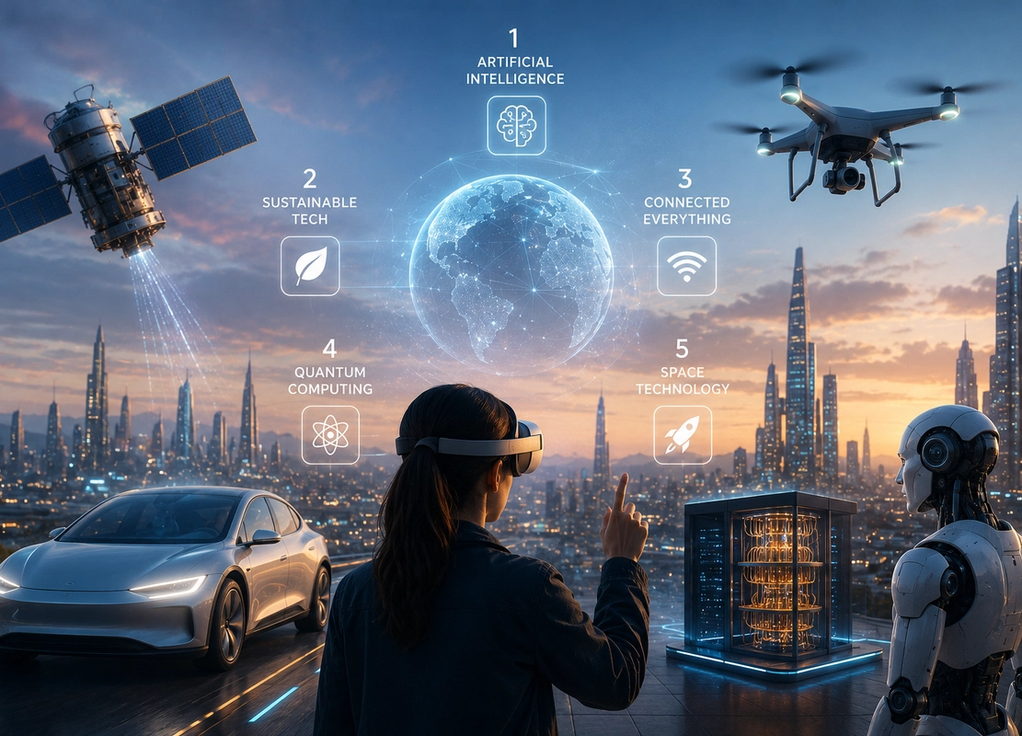
1. AI Becomes an Everyday Assistant
Artificial intelligence is moving beyond specialized applications and becoming part of everyday tools. Rather than existing as a separate technology, AI is increasingly being built into software, devices, and services that people already use.
Over the next decade, AI assistants are likely to help manage schedules, summarize information, support decision-making, and automate routine tasks. As these systems become more capable, they may function less like tools and more like collaborative partners that help individuals work more efficiently.
The biggest impact of AI may not be dramatic automation but the countless small ways it reduces friction in daily life.
2. Automation Expands Across Industries
Automation has traditionally been associated with manufacturing, but its influence is spreading into many other sectors. Advances in machine learning, robotics, and intelligent software are enabling businesses to automate increasingly complex processes.
Administrative tasks, logistics, customer support, data analysis, and operational workflows are all becoming more automated. This shift is likely to change the nature of many jobs, reducing repetitive work while increasing the importance of creativity, judgment, and human interaction.
The future of work may depend less on performing routine tasks and more on managing and collaborating with intelligent systems.
3. Personalized Health Technology Grows
Healthcare is becoming more data-driven and personalized. Wearable devices already track activity, sleep, heart rate, and other health indicators. Future technologies may provide even deeper insights into individual health patterns.
Advances in sensors, diagnostics, and predictive analytics could help identify potential health concerns earlier and support more personalized treatment plans. Rather than focusing solely on treating illness, healthcare systems may place greater emphasis on prevention and continuous monitoring.
This shift has the potential to improve outcomes while helping individuals take a more active role in managing their well-being.
4. Digital and Physical Worlds Become More Connected
The boundaries between digital and physical experiences are gradually becoming less distinct. Technologies such as augmented reality, virtual reality, and spatial computing are creating new ways for people to interact with information and environments.
While adoption may occur gradually, these technologies could transform education, training, entertainment, design, and remote collaboration. Instead of viewing digital content through screens alone, people may increasingly interact with it as part of their physical surroundings.
The result could be more immersive and intuitive digital experiences.
5. Sustainability Becomes a Technology Priority
As concerns about energy use, climate change, and resource management continue to grow, technology is playing a larger role in developing sustainable solutions.
Innovations in renewable energy, battery storage, smart infrastructure, and resource efficiency are likely to become increasingly important. Businesses and governments are investing heavily in technologies designed to reduce waste, improve efficiency, and support long-term environmental goals.
The next decade may see sustainability move from a niche concern to a central driver of technological innovation.
Why These Trends Matter
Technological change rarely happens in isolation. The most significant transformations occur when multiple innovations interact and reinforce one another.
Artificial intelligence can improve healthcare systems. Automation can support sustainability efforts. Immersive technologies can enhance education and training. The combined effect of these developments may be far greater than the impact of any single technology alone.
Understanding these trends is not just about predicting gadgets or products. It is about recognizing the forces that are likely to shape society, business, and daily life in the years ahead.
The Future Is Already Taking Shape
The technologies that define the next decade are not distant possibilities. Many of them are already influencing how people work, communicate, learn, and make decisions.
While no one can predict exactly how the future will unfold, certain patterns are becoming increasingly visible. AI, automation, personalized healthcare, immersive digital experiences, and sustainable innovation are all positioned to play major roles in the years ahead.
The next decade will not be defined by a single invention. It will be shaped by how these technologies come together to create new possibilities—and new challenges—for people around the world.