5 Things You Didn’t Know Were Powered by AI
Mary Shelby
June 6, 2026
When people hear the term artificial intelligence, they often think of chatbots, image generators, or futuristic robots. Yet AI has become so deeply integrated into everyday life that many people interact with it dozens—if not hundreds—of times a day without realizing it.
In many cases, the most influential AI systems are not the most visible ones. They work quietly in the background, helping apps function, improving recommendations, detecting problems, and making digital experiences smoother. Because these systems operate behind the scenes, their presence often goes unnoticed.
Key Takeaways
- AI is embedded in many everyday technologies
- Some of the most impactful AI systems operate invisibly
- AI often improves convenience rather than replacing human activity
- Recommendation and prediction systems are among the most common uses
- Many daily digital experiences rely on AI-powered decision-making
1. Navigation Apps and Traffic Predictions
When navigation apps suggest the fastest route to your destination, they are doing far more than displaying a map.
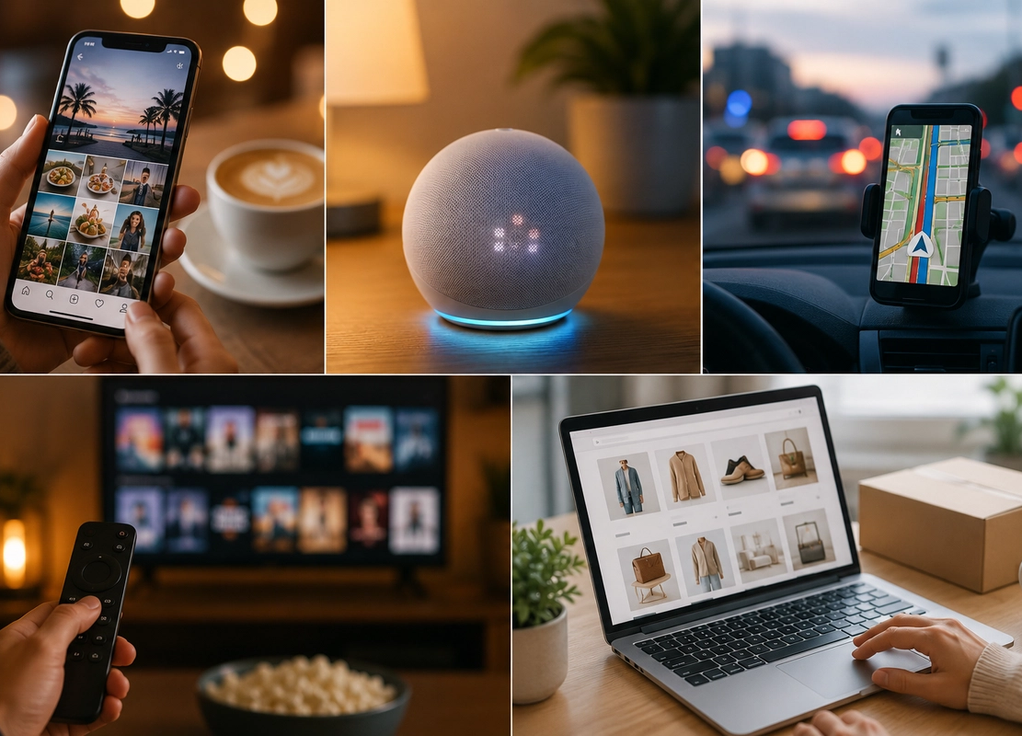
AI systems analyze massive amounts of data, including traffic conditions, road closures, historical travel patterns, and user activity. They continuously evaluate possible routes and predict which one is likely to get you to your destination most efficiently.
The result is a navigation experience that adapts in real time rather than simply following the shortest distance between two points.
2. Spam Filters in Your Email
Most people rarely think about spam filters until an unwanted email slips through. Yet these systems perform an enormous amount of work behind the scenes.
AI helps analyze incoming messages by identifying patterns commonly associated with spam, phishing attempts, and fraudulent content. The system continuously improves by learning from new examples and adapting to evolving tactics.
Without these tools, inboxes would be flooded with significantly more unwanted messages every day.
3. Streaming Recommendations
Whether you are watching movies, listening to music, or browsing videos, recommendation systems play a major role in what you see.
AI analyzes viewing habits, listening history, preferences, and behavioral patterns to predict content that may interest you. While no recommendation system is perfect, these algorithms are responsible for a large portion of the content people discover online.
Many users assume they are making completely independent choices, but recommendations often influence what appears in front of them in the first place.
4. Smartphone Photography
Modern smartphone cameras rely heavily on AI to produce the images people see.
When you take a photo, AI can help adjust exposure, improve lighting, reduce noise, sharpen details, identify subjects, and enhance colors. Portrait modes, night photography, and automatic scene optimization often depend on machine learning systems working behind the scenes.
In many cases, the final image is the result of both camera hardware and AI-powered processing.
5. Online Shopping Suggestions
The products displayed while shopping online are rarely shown at random.
AI systems analyze browsing behavior, purchase history, product popularity, and customer preferences to predict what someone may want to buy. These systems help personalize the shopping experience by highlighting items that are likely to be relevant to each user.
While this can make shopping more convenient, it also demonstrates how frequently AI is involved in everyday digital decisions.
Why Most AI Goes Unnoticed
The most successful technologies often become invisible. Once people grow accustomed to a tool, they stop noticing the complexity behind it.
AI follows this pattern. Instead of appearing as a standalone feature, it increasingly functions as a background technology that improves speed, convenience, and personalization. Many users benefit from AI every day without consciously thinking about it.
This quiet integration is one reason AI feels simultaneously revolutionary and ordinary.
The Hidden Layer of Modern Technology
Artificial intelligence is no longer limited to specialized applications or futuristic experiments. It has become part of the infrastructure that powers many of the digital services people rely on daily.
From filtering emails and guiding drivers to recommending entertainment and improving photographs, AI is quietly woven into countless experiences. Its influence is often subtle, but its impact is significant.
The next time an app predicts what you need, recommends something you enjoy, or saves you time, there is a good chance AI is working behind the scenes—even if you never notice it.